
No president in Nigeria’s history received more public endorsements for a second term than Goodluck Jonathan. Politicians across party lines, governors, senators, traditional rulers, religious leaders, billionaire businessmen, and over 10,000 well-funded support groups flooded the airwaves daily, confidently predicting his victory—some even before noon on election day.
For Jonathan’s administration, money was never a constraint. Funds were recklessly thrown at anyone who showed the slightest support—so much so that merely greeting “Mama Peace” with a “Good morning” could attract largesse.
A month to the February 2015 elections, the Jonathan government secretly commissioned an international poll expert to predict the election outcome. The result? A shocker. The poll predicted Jonathan would lose if the election were held as scheduled. Alarmed, the president summoned the National Security Adviser (NSA), Sambo Dasuki, and the head of the DSS. Their internal intelligence confirmed the grim forecast: the North was mobilized and ready to vote Jonathan out.
In a state of panic, and despite nationwide outrage, the Jonathan administration postponed the elections by six weeks. The official reason was to address insecurity in the North-East, a region long neglected under his watch. Ironically, the same Jonathan government that allowed Boko Haram to displace thousands—hoping the chaos would suppress Northern voter turnout and give him an advantage in the South and North Central—was now racing to deploy troops and reclaim territory, not out of concern for the people, but to rescue a failing re-election bid.
Why the sudden urgency? The NSA and DSS warned that Northerners were determined to defy the odds and cast their votes. INEC Chairman Attahiru Jega also resisted pressure to cancel elections in the troubled North, insisting that adequate arrangements were in place, even for displaced persons.
Jonathan was boxed in. He delayed the polls, deployed military resources, and hoped that his last-minute efforts would appease Northern voters. But it was too little, too late. The North saw through the charade and rejected him.
In desperation, Dasuki was dispatched to London to brief the international community on the “justification” for the postponement. On his return, the doors of the Central Bank were flung open to him. Billions in naira and dollars were siphoned—allegedly to buy arms, but in reality, used to bankroll Jonathan’s re-election campaign. The infamous $2.1 billion arms procurement fund became a political war chest, enriching cronies and drowning support groups in cash.
Even former Sokoto State Governor Attahiru Bafarawa reportedly received ₦4.6 billion (over ₦40 billion in today’s value) to hire local and international marabouts, witch doctors, and prayer warriors for Jonathan’s victory.
But did all of this save him?
No. Nigerians spoke loudly on election day and threw Jonathan out of power. The APC itself was stunned by the scale of its victory, and the PDP remains in denial to this day.
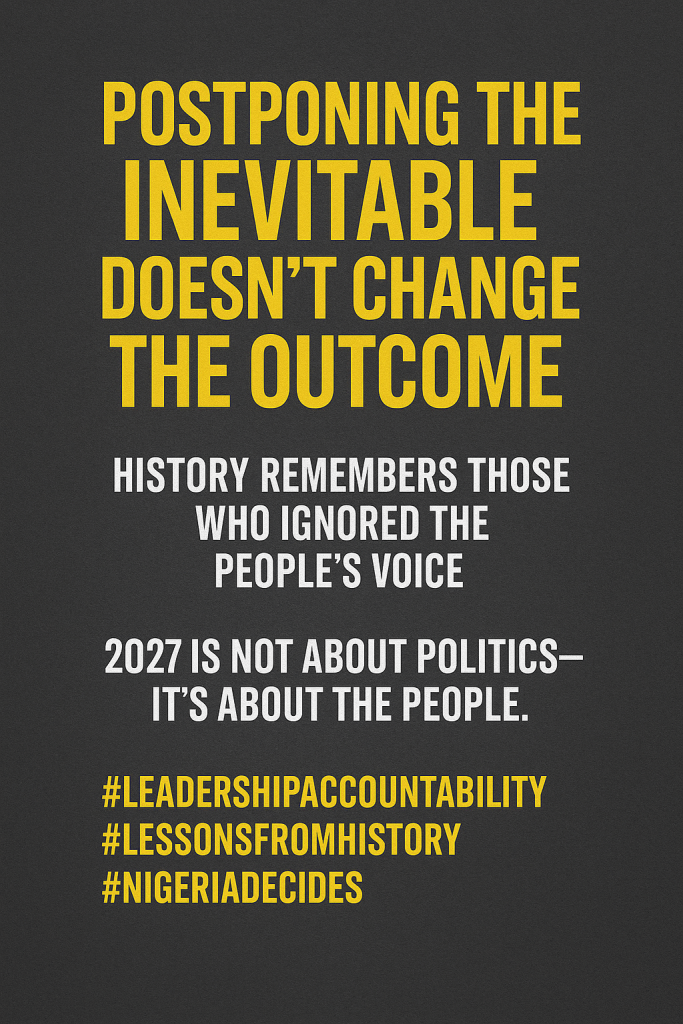
Fast forward to 2025, President Tinubu, buoyed by arrogance and flattered by sycophants who crown him a “master strategist,” is blindly walking the same path that ended Jonathan’s reign. But history teaches hard lessons.
No leader who ignores or torments the Nigerian people walks away unscathed. Nigerians may appear passive, docile, or defeated, but when the time comes, they strike back—with the ballot or by force of will.
Make no mistake: 2027 is not about APC versus opposition parties. It is a battle between the suffering masses and the architects of their torment. The level of hardship under Tinubu’s APC is unprecedented—far exceeding anything experienced under Jonathan. Yet, Tinubu and his cheerleaders carry on, deluded and indifferent.
The warning signs are clear. Obasanjo once responded to a journalist asking if the 2015 election postponement would help Jonathan win:
“Postponing the funeral doesn’t wake up the dead. You’re only delaying the burial.”
That analogy is more relevant today than ever. Tinubu’s administration is already politically “dead” in the hearts of Nigerians. The charade of endorsements, the wasteful “validation” events, and the careless squandering of public funds won’t change the outcome. Nigerians are watching, and they are waiting.
Nigeria is too vast, too diverse, and too proud to be subdued by any one man or cabal. Those who attempt it always learn the hard way.


 OBLONG MEDIA GLOBAL INTELLIGENCE
Leave a reply to Say Cancel reply